
Duesenberg Multibender






-
Description
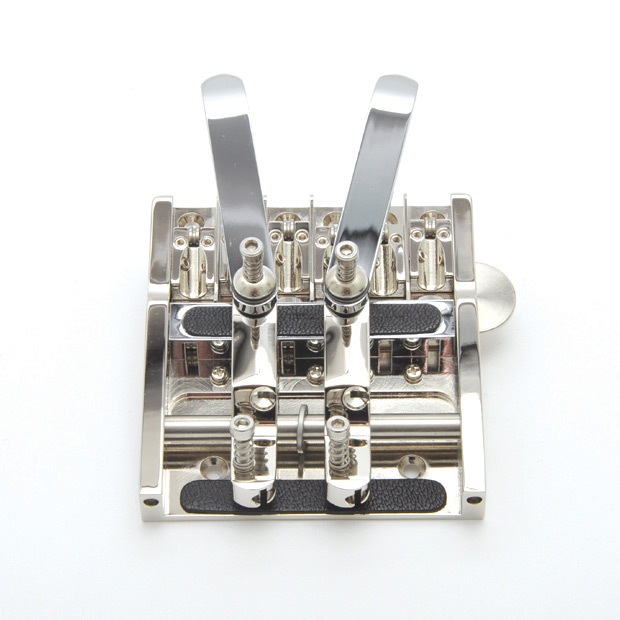
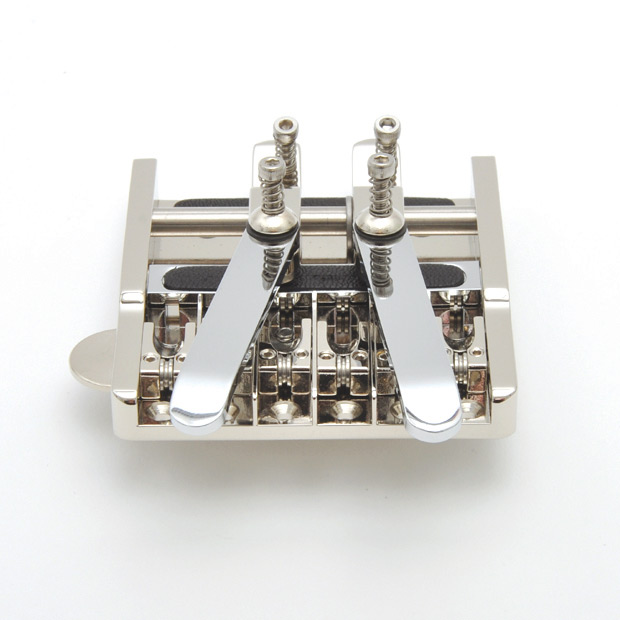
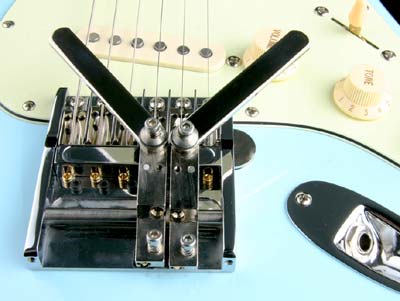
The Duesenberg-Multibender is a replacement-bridge for Strats and Teles. On a Strat® the Multibender can be installed easily without any modifications (this assumes an existing routing for tremolo and a spacing of 56mm between the two outer tremolo screws). The string-lever allows the bending of the string in two (tonal-)directions for one or two halftones. Combining this with open tunings and slide-method-playing, quite realistic Pedalsteel-sounds can be achieved. But the Multibender also works in standard tunings and playing-methods. In this case you can achieve the wellknown B- and G- Bender sounds.
Dimensions of the baseplate: 82 x 74 x 14,5 mm. String spacing: 54 mm.
The Multibender in it's basic version includes two levers. But it can be expanded anytime with additional levers. On these videoclips (see details), the outstanding guitarist Martin Huch(who was deeply involved in the development of the Multibender, and also is one of the guitarists playing on our legendary "Rockinger All Pickup Check CD") demonstrates the amazing possibilities of this bridge.
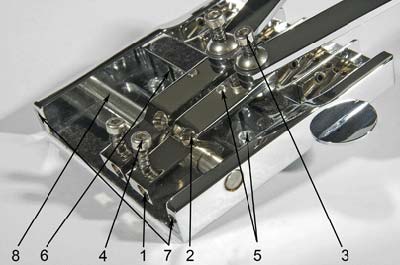
- Hier wird die Saite eingefädelt, wenn sie gehoben werden soll.
- Hier wird die Saite eingefädelt, wenn sie gesenkt werden soll.
- Stimmschraube für den Zielton (Hebel gedrückt)
- Einstellschraube für die Ausgangsposition (Hebel nicht gedrückt)
- Zwischen diese beiden Schrauben wird die Rückdruckfeder gestellt, wenn die Saite gesenkt werden soll.
- Mittelsteg mit den Umlenkrollen (beim Einfädeln der Saite sicherstellen, dass diese UNTER der Rolle durchgeführt wird !)
- Wenn zusätzliche Hebel integriert werden sollen, diese beiden Inbusschrauben lösen, um die Achse (8) entnehmen zu können.


